The Counter Has One Job at a Time
A small worktop stays useful when each task has a clear turn. Set up a landing place, prepare in sequence, and clear the surface before the next job begins.
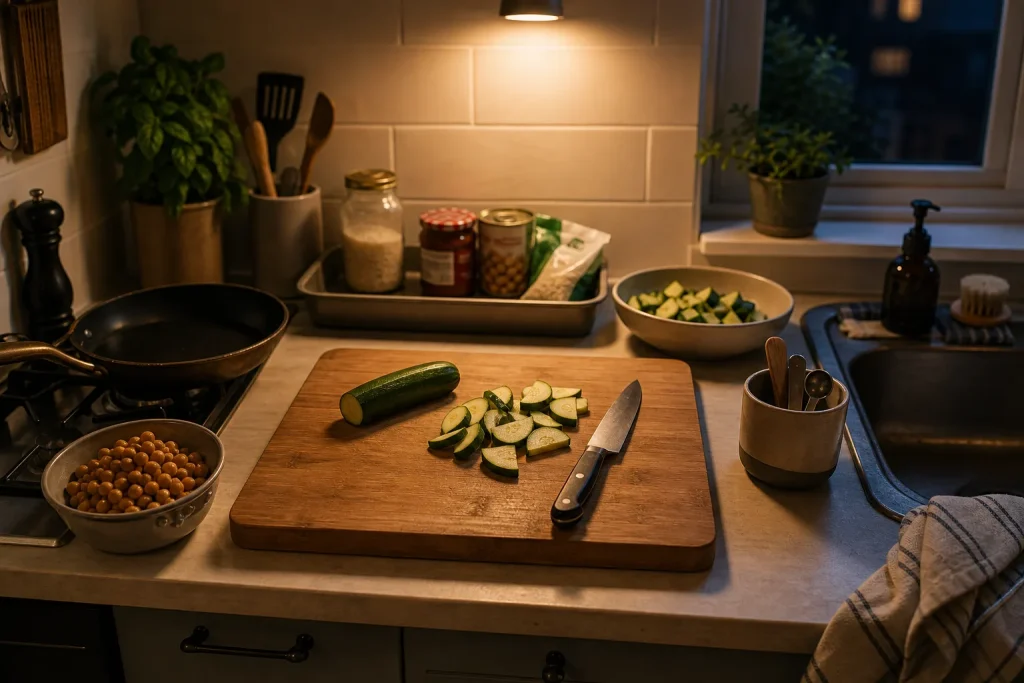
On a narrow kitchen counter, a chopping board can be enough workspace for a whole supper—if nothing else is trying to use it at the same time. The useful habit is to give the surface one job, finish that job, then clear it before starting the next. Ingredients, utensils and washing-up can wait in defined places rather than gathering around the board.
This is not about making a compact kitchen look immaculate. It is about preserving a clear patch for the task that needs your hands now. A bowl can hold chopped vegetables; the sink can receive used utensils; an unused hob ring can act as a temporary landing spot, provided it is cool and dry. With a modest sequence, the worktop becomes a station you can reset, not a shelf that happens to have a board on it.
Where will each thing wait?
Before opening packets or reaching for a knife, choose three destinations: one for ingredients that are still waiting, one for prepared food, and one for used equipment. These can be a plate, a mixing bowl and an empty section of the sink. If space is very tight, a clean tray or shallow roasting tin can gather the waiting ingredients without spreading them across the worktop.
Keep the chopping board in the middle of the available space, with its long edge facing you. Put only the tools needed for the first task beside it. A knife belongs within easy reach; the peeler, tin opener or measuring spoon can stay in a drawer until its turn. Leaving every possible tool out does not save much time if it makes the working patch hard to use.
Think about what can safely wait at room temperature and what needs to stay chilled. Leave raw meat, fish and other perishable ingredients in the fridge until you are ready to handle them, and keep their packaging and juices away from ready-to-eat foods. If food handling or an appliance raises a safety question, follow reliable food-safety guidance rather than improvising to save counter space.
What should come out first?
Start with the ingredient or tool that will not make the surface messy. Read the recipe through once, then take out the ingredients for the first task, not every ingredient for the whole meal. A jar, a bag of rice and a tin of beans can wait on the tray while you rinse and chop the vegetables needed first.
Gather small items together before they become clutter. Put spices in a mug, for instance, and keep the recipe or phone at the back of the counter, away from splashes. If you are using a phone, set it somewhere it will not need to be moved every time you reach for a bowl; a written note on a scrap of paper may be simpler in a cramped space.
Now clear the board of anything unrelated. Move the kettle, post or breakfast plate elsewhere if you can, and wipe away crumbs. A brief reset at the start is easier than trying to chop around yesterday’s clutter.
How do you prepare without crowding the board?
Work in batches that fit comfortably on the board. Wash the vegetables, let excess water drain, then cut the ingredient you need first. Transfer each finished batch straight into its waiting bowl or plate. The board is for cutting, not for storing every prepared ingredient until the end.
Choose the order to limit awkward changes. If a meal uses several vegetables, cut the cleanest or least aromatic ones first, then move on to ingredients with stronger flavours. Keep raw meat separate, using a different board if you have one. If you have only one board, prepare vegetables first, then handle raw meat later and clean the board and knife thoroughly before they touch anything else.
Say you are making a quick pan of courgette, chickpeas and eggs, and the only clear worktop is about the size of a chopping board. You could put the rinsed chickpeas in a bowl, slice the courgette on the board and tip it into a second bowl, then set the knife aside while you wipe the board before cracking the eggs into a cup. The expected result is a clear board for the next task, with each ingredient ready in its own place rather than piled together on the counter.
Keep the prepared bowls close, but not on the cutting area. A plate on the far side of the board is often enough. If there is no spare counter, place the bowl on a cool, stable part of the hob only when the hob is off and not warm; otherwise use a sturdy chair or table nearby. Avoid balancing food on an appliance or stacking containers where a small bump could send them down.
When is the board ready for another job?
Once chopping is finished, move the knife to the sink or a designated utensil rest, scrape vegetable scraps into the bin or compost caddy, and wipe the board. Do not leave a knife hidden under a tea towel or mixed into a sink full of dishes. If the next task involves ready-to-eat food, wash the board and knife with hot, soapy water and dry them before continuing.
Then decide whether the board should stay out. For a task that needs it, such as slicing bread or portioning cooked food, clean it and return it to the centre. For a task that needs a dry surface, put it away and wipe the counter. A clear counter is not wasted space; it is the next station waiting to be used.
Used tools need a destination too. Put a spoon or peeler in the sink, but avoid filling the whole basin with washing-up if you still need it for rinsing. If the sink is needed, wash one or two essential items straight away, dry them, and return them to the drawer. The aim is not to wash every dish as you cook; it is to keep the next task from being blocked.
How should the surface change during cooking?
Cooking brings its own transitions. When the prepared ingredients are ready, move the bowl you need next beside the hob and put the rest somewhere stable. Keep the worktop free for the action that follows, such as draining pasta, opening a tin or stirring a sauce. If you are using a hot pan, leave enough clear space to set down a lid or spoon without crowding it against food.
Set a heatproof mat or trivet in a spot that will remain clear. A folded tea towel is not a reliable substitute beside a hot hob, especially if it can trail towards a flame or touch a hot element. Keep handles turned inwards where appropriate, and avoid putting hot cookware on a surface that may be damaged by heat.
As ingredients go into the pan, return their empty bowls and packets to the sink or recycling area. Fold a packet closed if it still contains food, and put chilled leftovers back in the fridge rather than leaving them out while you finish cooking. These small departures keep the counter from filling again just as the pan needs attention.
What if the next task arrives before the first one is clear?
Pause and make a short reset instead of adding another layer. Put the food already prepared into its bowl, move the tool you have finished with, and clear crumbs or spills. If the next task is urgent, decide what can safely wait: an unopened tin can stay on the tray, while a hot pan should not be left unattended simply to make the counter tidy.
Sometimes the bottleneck is not the counter but the sink or hob. If the sink is full, move clean, dry items to a cupboard or drying rack before adding more washing-up. If the hob is occupied, do not use a warm ring as a landing place; choose a table or leave the ingredient in the fridge until needed. Give each item a temporary home that does not interfere with cooking or create a hazard.
For a particularly tight kitchen, use a tray as a portable holding area. It can carry the ingredients for one stage from fridge to counter, then leave the worktop once the food is in the pan. The tray does not create more surface, but it makes it easier to move a group of waiting items together rather than shuffling them one by one.
How do you finish with a usable counter?
When the food is cooking or served, clear the final round of tools and wipe the area that held raw ingredients. Wash the board and knife promptly, and put away ingredients that need chilling. Leave clean dishes to dry if washing them all would crowd the sink; just keep the space you need for serving or the next ordinary kitchen task open.
Make the reset specific rather than aiming for a perfect kitchen. Put away the knife, return the salt and oil to their usual places, wipe the chopping area and move scraps to the bin. If a pan still needs soaking, leave it in the sink without blocking the tap or the place where you wash your hands.
Next time, the first move is easy to remember: choose where waiting ingredients, prepared food and used tools will go. Then let the counter change jobs only after the current one is finished. That modest pause is what keeps a small worktop useful from the first cut to the last wipe.